DRESS WITHOUT
LIMITS.
Professional-grade virtual try-ons for the modern shopper. Experience high-fashion collections in your digital dressing room.
Live Try-On Demo
Upload photo & pick outfit
* Tap more than one to build a full outfit
Precision Generation
Studio-grade virtual try-ons that respect fabric texture and drape.
Real-time Dressing
Instant visualizations across entire collections with zero latency.
Secure Data
Your customers' biometric data is encrypted and protected by RLS.
Global Marketplace
List your products in the emode marketplace for worldwide discovery.
TRY ON ANYTHING, ANYWHERE
Access emodeAI through your favorite platforms and transform your shopping experience.
Chrome Extension
Try on clothing across any website with AI directly in your browser.
Chrome Web StoreEmbedded Widget
Customizable JS injection for direct deployment. Restricted to Growth plans.
View PlansINVEST IN YOUR BRAND
Starter
Let customers see it on themselves.
- Virtual try-on widget
- Embed on your website
- Basic analytics
- Emode branding
- AI model image generation
- Marketplace access
- Storefront
Pro
Replace photoshoots with AI.
- Everything in Starter
- AI-generated model images
- Asset library & management
- Advanced analytics
- Faster processing
- Remove Emode branding
- Marketplace access
- Storefront
Growth
Unlock distribution when it launches.
- Everything in Pro
- Priority processing
- Early access features
- Marketplace access
- Dedicated Support
Phase 2: Emode Marketplace
The Emode marketplace connects shoppers with brands through permanent, priority access and preferential placement.
Growth (Monthly)
Marketplace access unlocks at launch and remains active while subscribed.
Lifetime Founder
Permanent, priority access with preferential placement and storefront.
Questions
Still stuck? Email us.
They open a product page, tap Try This On, and upload a photo of themselves. A few seconds later they see that garment on their own body. No app, no account, no measurements — and they can add several pieces to a dressing room and see the whole outfit at once.
Good enough to answer "does this suit me" — the cut, the colour, the proportions on your body. It is not a tailoring tool and will not tell anyone their exact size. Results are best from a full-body photo, taken straight on, in even light. Shoppers get an unlimited number of attempts against their daily allowance, so a bad photo is one retry away from a good one.
The photo is used to generate the try-on and nothing else. It is not sold, not shared with other merchants, and not used to train models. We do not build a profile of the person from it. Full detail is in the privacy policy, including the third parties involved in generating an image.
Shopify has a dedicated app. Everywhere else — Webflow, Squarespace, WooCommerce, BigCartel, a custom Next.js build — it is one line of script before your closing body tag. It finds your products on its own from the structured data your store already publishes, so there is nothing to configure and no per-product setup.
The script is under 10KB and loads after your page. It renders two buttons and does nothing else until somebody taps one — the try-on itself runs on our servers, in a panel over your page, not in your storefront.
Product views, try-ons, try-on rate and a per-product breakdown are there from the first page view. Conversion, order value and returns need order data: automatic for Shopify, or one function call on your confirmation page for everyone else. The dashboard tells you which of those it has rather than showing you zeros as though they were findings.
A shared storefront where shoppers browse pieces from every brand on emode and try them on before clicking through to buy. It is included on Pro and above. It has not launched yet — there are no listings in it today, and we would rather say so than have you find out. Your plan reserves your place; publishing your products is one toggle when it opens.
Both work. A flat lay or a cutout on white gives the cleanest result, because there is no second body for the model to reason about. If your catalogue is shot on models, it still works — just expect the occasional retry.
Monthly plans cancel any time and run to the end of the period you have paid for. Lifetime plans are one payment with no renewal. Removing emode from your store is deleting one line of code.
The storefront is
where it starts.
First the widget, then the marketplace, then this: emode as an app. The try-on engine brands put on their product pages, plus a social feed and a place to buy and sell — so you can see a piece on yourself, share the look, and shop it, wherever you found it.
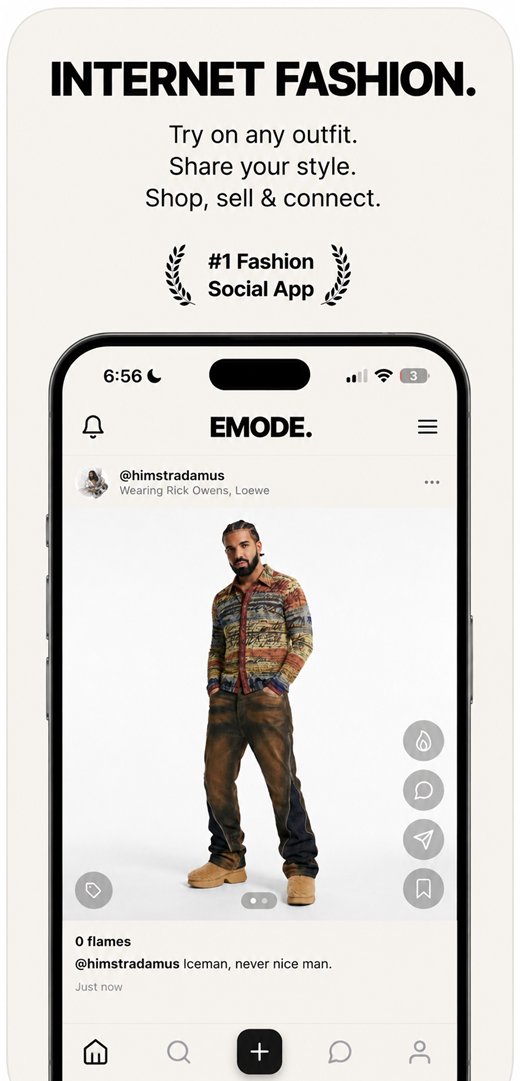
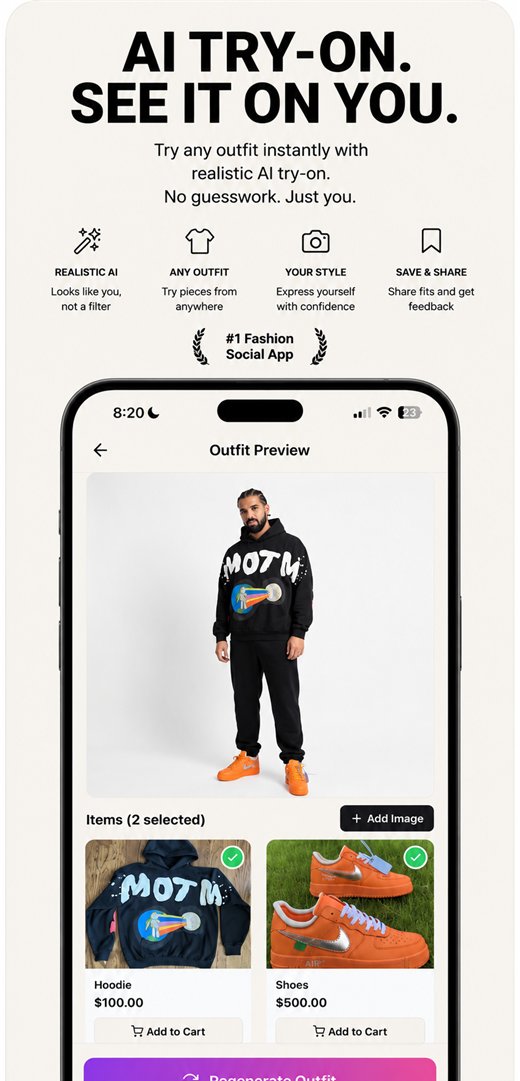
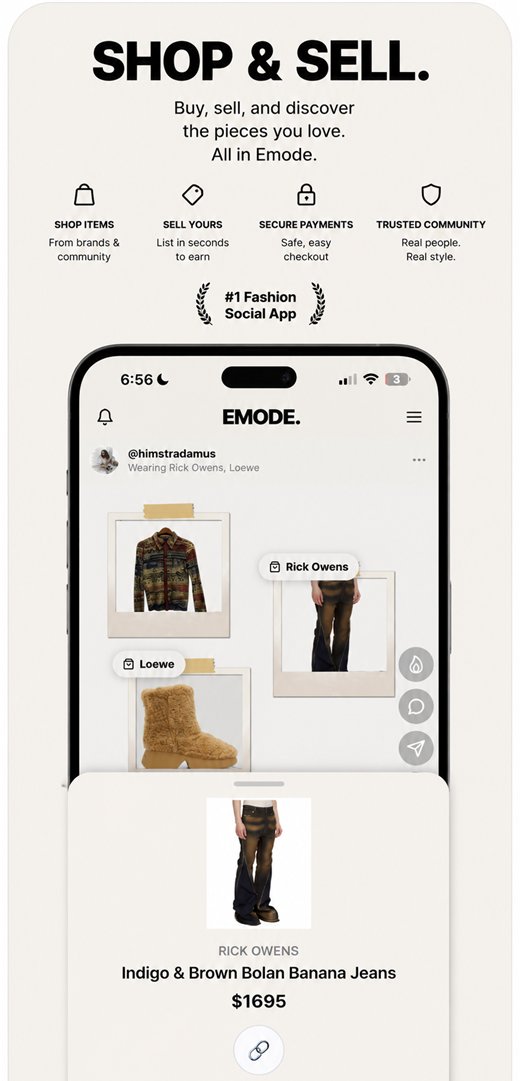
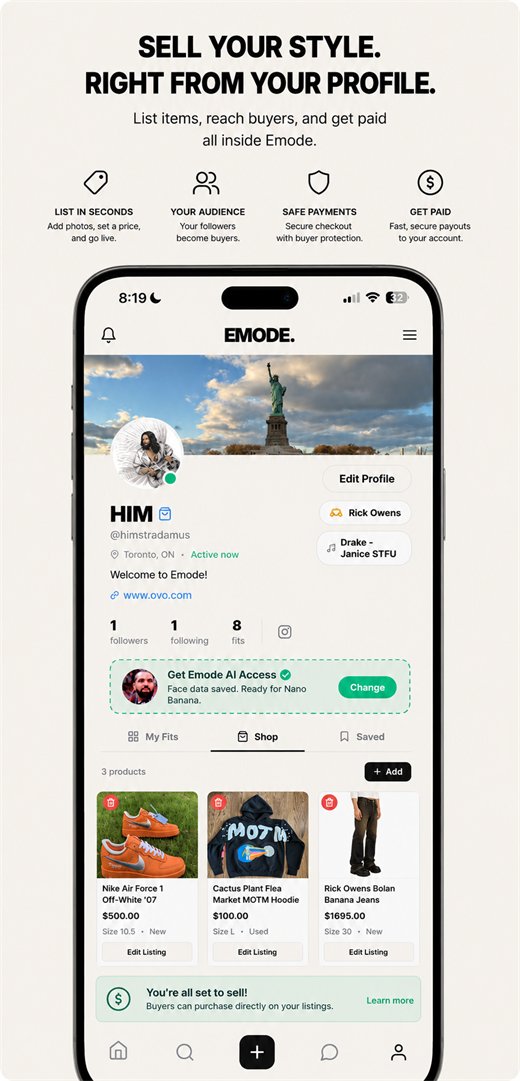
Try it on before you buy it
Drop a photo, drop a fit, see yourself wearing it. The same engine brands run on their storefronts, pointed at anything you find anywhere.
A feed built on outfits
Follow people whose taste you trust. See clothes on bodies that look like yours, instead of on a model who was cast.
Sell your closet — and let buyers try it on
List secondhand pieces the way you would anywhere else. The difference: a buyer can see the piece on themselves before they commit. Nobody else can do that, because nobody else has the try-on engine underneath the marketplace.
Style other people
Build looks on someone else and send them. Stylists get a storefront where the work is the product, and a client sees the fit on themselves before a single piece is bought.
Get early access
We let people in a few at a time. No spam — you'll hear from us when your spot opens, and not otherwise.
iOS only for now, via TestFlight.
iOS · Android · Web


Drops, previews, and the styling chaos.